
All guides / Gear & Buying Guides
Best Cat Trees for Small Apartments: What to Look For Before You Buy
At a glance
- Measure the full footprint, including overhangs and access routes.
- Compare stability, platform dimensions and cleaning needs before height.
- Follow manufacturer guidance; this is a selection guide, not a hands-on product test.
In this guide
- Measure the available footprint first
- Spot safety red flags in product photographs
- The six features worth comparing
- Three layouts for different apartments
- What about ceiling-tension cat trees?
- A five-minute product comparison checklist
- Compare two shortlisted trees without guessing
- Frequently asked questions
- Related guides
- Sources and further reading
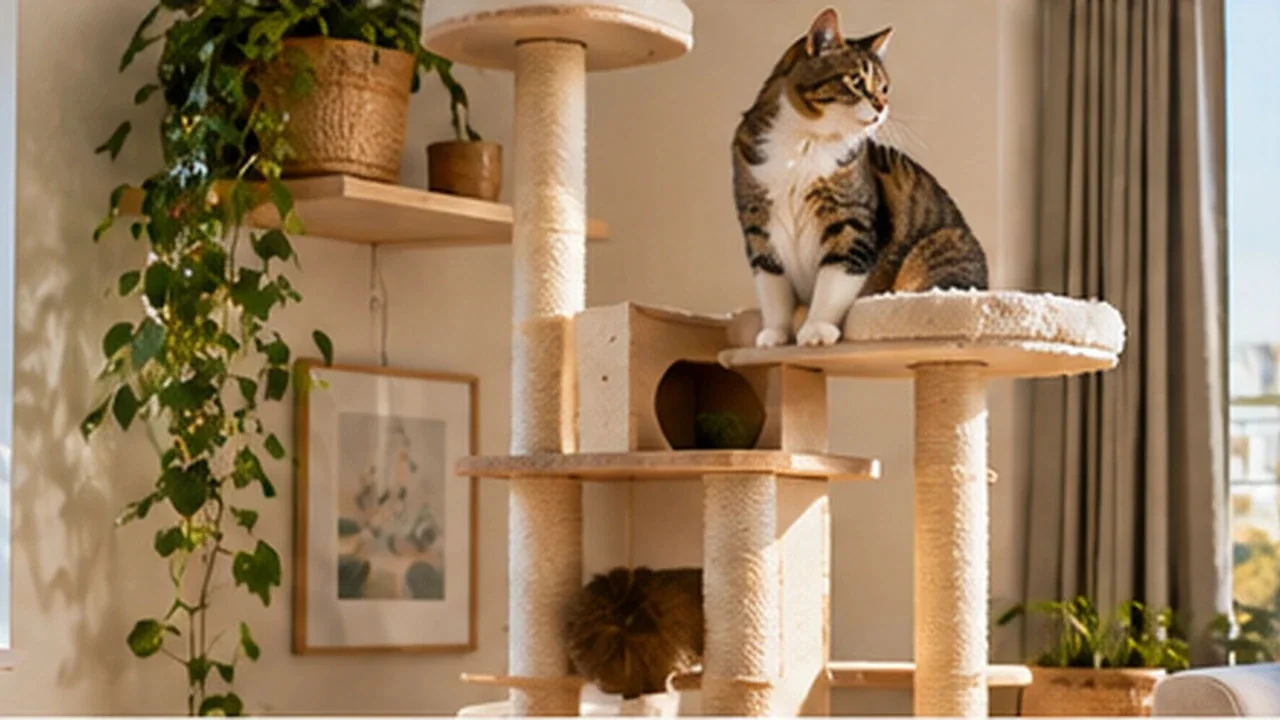
When floor space is limited, a good cat tree earns its place. It gives your cat somewhere to perch, scratch, hide, and observe without requiring several separate pieces of furniture. But the tallest or most elaborate model is not automatically the best fit.
The most useful small-apartment cat tree is stable, easy to access, appropriately sized for your cat, and located where your cat wants to spend time. This guide explains how to compare features; it does not pretend that we have hands-on tested models we have not used.
Measure the available footprint first
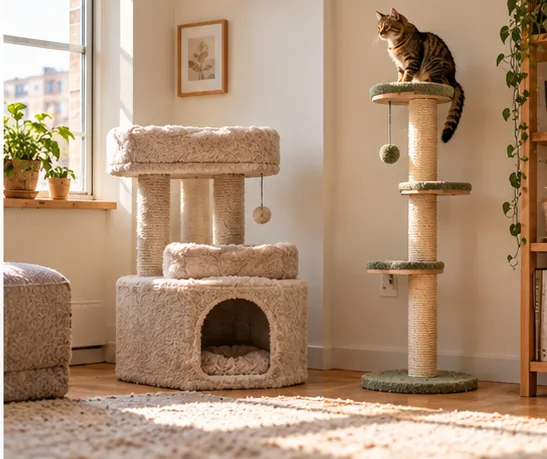
Comparison only: both depicted trees include dangling ball accessories, which may detach or tangle. Do not assume these are safe unsupervised. Compare base footprint, support and the manufacturer’s accessory instructions instead. AI-generated editorial illustration.
Use painter’s tape on the floor to mark the maximum base dimensions. Leave room for doors, walkways, heating vents, and access to litter and water. The footprint includes the full base and any overhanging hammock, bed, or ladder—not only the narrow central post.
A common mistake is to buy for height alone. A very tall, narrow tree can be less secure than a shorter model with a broad base and appropriate wall anchoring. Follow manufacturer installation and weight guidance.
Spot safety red flags in product photographs
A marketing photo may show a tall climbing tower and a relaxed cat, but it cannot verify structural stability or the strength of a fastener. Some of the AI illustrations in this guide deliberately include dangling pompom accessories and tall narrow structures. Treat those details as features to question, not safe installation instructions.
- Dangling or detachable toys: Check whether a string, elastic, bell, pompom or other accessory could detach, unravel or become caught. Cornell’s toy-safety guidance recommends avoiding swallowable small pieces and string-like components [4]. Do not leave questionable hanging attachments accessible while your cat is unsupervised.
- Narrow base and tall post: Photos cannot establish tip resistance. Look for explicit dimensions, load guidance and anchoring requirements. If no reliable specifications are available, do not infer stability from the picture.
- Upper platforms and hammocks: Check usable resting area, fastening points and the cat’s weight, not just the advertised total height.
- Near windows: Even a stable structure cannot make an unsecured window safe. Keep windows protected and follow the mounting instructions for the specific product.
The photographs here are editorial illustrations, not manufacturer diagrams or evidence of hands-on testing. Use the safety questions in this guide to evaluate a real product separately.
The six features worth comparing
1. Stability and construction
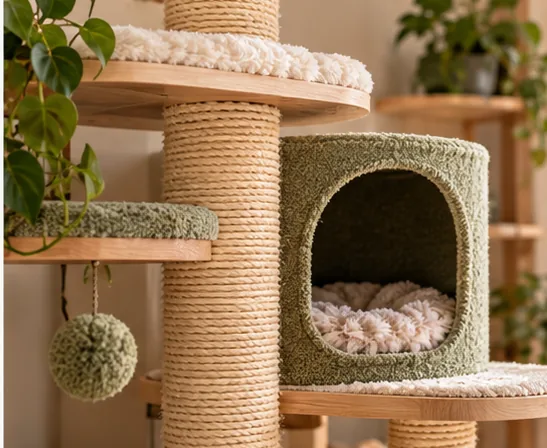
The image shows a hanging pompom; this is a visual feature to assess, not a recommendation for unattended use. Check scratching post joints, platform supports and any accessory’s detachable parts. AI-generated editorial illustration.
Look for a wide base, solid connections, replacement parts where available, and explicit assembly instructions. Once assembled, gently check for wobble without your cat present. If anchoring is specified, install it into a suitable structural surface using appropriate hardware or professional help.
2. Perch size
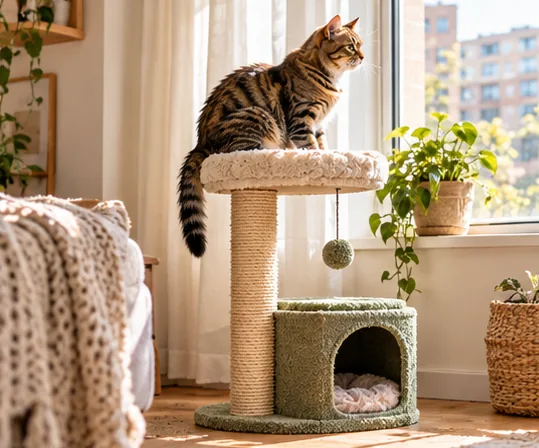
A platform must fit the actual cat. The dangling ball shown is not verified for unsupervised safety; compare the manufacturer’s usable dimensions, load limits and installation guidance. AI-generated editorial illustration.
Your cat should be able to turn, rest, and stretch on the main platform without hanging over an uncomfortable edge. Check actual platform dimensions, not only the product’s total height. Larger cats may need wider platforms and higher supported load ratings.
3. Accessible steps
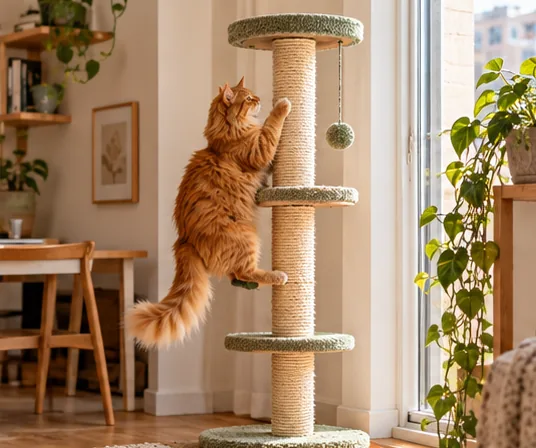
This tall, narrow tree is an example of features to scrutinize: anchoring, stability, step spacing and the hanging ball. Do not copy the picture as a verified safe setup. AI-generated editorial illustration.
Consider the spacing and route between platforms. Kittens, senior cats, and cats with mobility limitations may benefit from lower steps and more landing space. Do not assume your cat can jump safely just because a product is marketed for all ages.
4. A real scratching surface
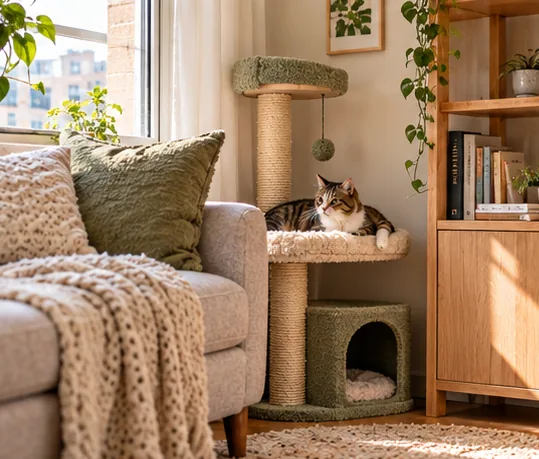
Look for a scratcher your cat can access and a base that stays stable. The hanging pompom in this illustration is not tested for detachment or entanglement; avoid unsafe loose accessories. AI-generated editorial illustration.
Scratching posts should be tall enough for a comfortable stretch and made of a material your cat likes. Some cats favor sisal, others cardboard or carpet. The Ohio State Indoor Pet Initiative recommends selecting orientation and material based on the cat’s behavior [1].
5. Cleanable materials
Washable removable cushions and easy-to-vacuum shelves make maintenance simpler. Check whether fabric coverings can be replaced and whether crevices trap fur or debris.
6. Useful placement
A secure tree by a closed, protected window or near your cat’s favorite resting area may get more use than one hidden behind furniture. Keep it away from fragile items and unsecured open windows.
Three layouts for different apartments
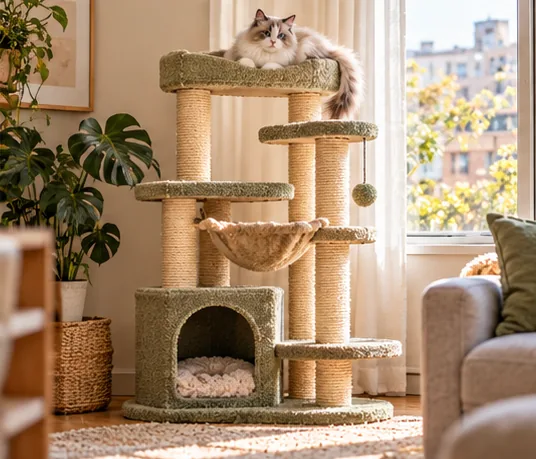
The illustrated large tree and hanging ball are not product-tested. Verify actual platform dimensions, supported weight, installation and attachment security before choosing a design. AI-generated editorial illustration.
The corner tree: A compact base with two or three staggered platforms. Good when your room has a clear unused corner and enough room for safe jumping.
The low, wide tree: Several comfortable steps with a moderate top perch. Worth considering for cats that prefer easy access or larger resting platforms.
The wall-supported climbing system: Potentially frees floor space but requires correct installation, suitable walls, and secure anchors. Not ideal for every rental property.
What about ceiling-tension cat trees?
Tension designs can save floor space, but stability depends on the ceiling type, installation, correct tension, and maintenance. Follow the exact product instructions. Never assume a tension pole is safe for a heavy or very active cat without checking manufacturer limits and mounting conditions.
A five-minute product comparison checklist
Before buying, record: assembled footprint, total height, widest platform, step spacing, declared load capacity, anchoring requirements, materials, washable parts, spare-part availability, and return policy. Compare actual measurements rather than phrases such as “space saving” or “extra sturdy.”
If a seller omits crucial measurements or does not explain how the tree stays stable, consider another product. For a cat that struggles with stairs or jumping, ask your veterinarian about suitable access and activity levels.
Compare two shortlisted trees without guessing
If two models look similar online, make a simple specification sheet rather than relying on claims such as heavy duty or perfect for apartments.
| Check | Model A | Model B |
|---|---|---|
| Assembled base footprint and any overhang | Record dimensions | Record dimensions |
| Usable resting-platform size | Record dimensions | Record dimensions |
| Manufacturer’s supported load and usage limits | Record the exact wording | Record the exact wording |
| Mounting or anchoring required | Record instructions | Record instructions |
| Access for your cat’s mobility | Observe step spacing | Observe step spacing |
| Washable covers and replacement parts | Check availability | Check availability |
| Returns and warranty | Verify seller terms | Verify seller terms |
If any essential safety specification is missing, ask the seller before ordering. A photo of a large cat on a product is not a substitute for measured capacity or appropriate installation. When a product arrives, inspect all fittings and assemble it exactly as instructed before allowing use.
Frequently asked questions
Does every indoor cat need a cat tree? Not necessarily. Cats benefit from suitable scratching, resting, hiding, and elevated options, but these can be provided in different ways [2].
Is a window-side cat tree safe? It can be if the structure is stable and the window is secured. The ASPCA warns about falls from open or inadequately protected windows [3].
How often should I inspect a cat tree? Check for loosened joints, damaged fabric, frayed rope, and wobble during regular cleaning; follow manufacturer maintenance instructions.
Related guides
- How to Create a Cat-Friendly Apartment
- Window Perches vs. Cat Trees
- How to Set Up a Home for Two Indoor Cats
Sources and further reading
- Ohio State University Indoor Pet Initiative, Scratching: https://indoorpet.osu.edu/node/449
- AAFP/ISFM, Feline Environmental Needs Guidelines: https://pmc.ncbi.nlm.nih.gov/articles/PMC11383066/
- ASPCA, High-Rise Syndrome: https://www.aspca.org/news/high-rise-syndrome-lifesaving-tips-cat-parents
- Cornell Feline Health Center, Safe toys and gifts: https://www.vet.cornell.edu/departments-centers-and-institutes/cornell-feline-health-center/health-information/feline-health-topics/safe-toys-and-gifts
Editorial and affiliate disclosure: This is a feature-based buying guide, not a hands-on product test or a ranked recommendation. Add product links only after verifying specifications, retailer terms, and disclosures.
Illustration note: Images are original AI-generated editorial illustrations, not photographs of tested products or certified-safe installations. Follow the written safety guidance and manufacturer instructions rather than copying incidental visual details.
Keep exploring
Window Perches vs. Cat Trees: Which Is Better for Your Indoor Cat?
Compare cat window perches and cat trees by floor space, stability, activity level, cleaning, and safety before choosing the right setup.
Read the guide →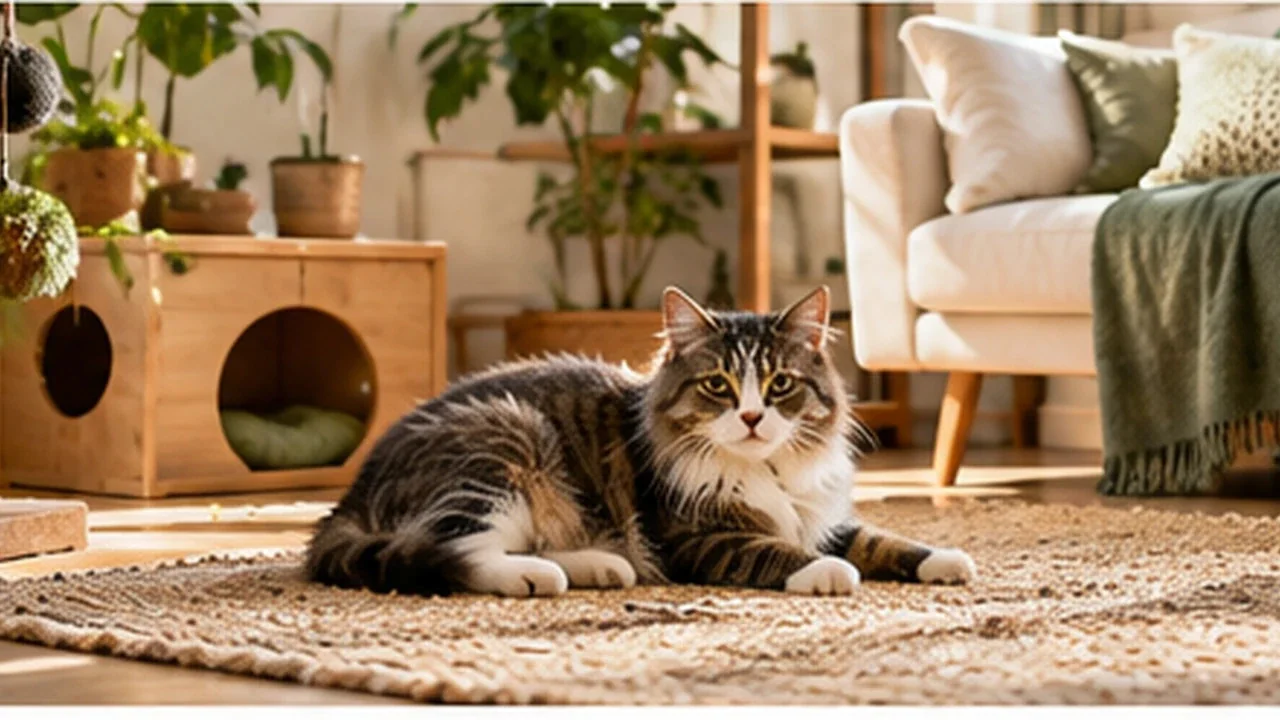
How to Create a Cat-Friendly Apartment Without Renovating
Make your apartment more cat-friendly with safe hiding places, scratching areas, vertical space, and a room-by-room checklist.
Read the guide →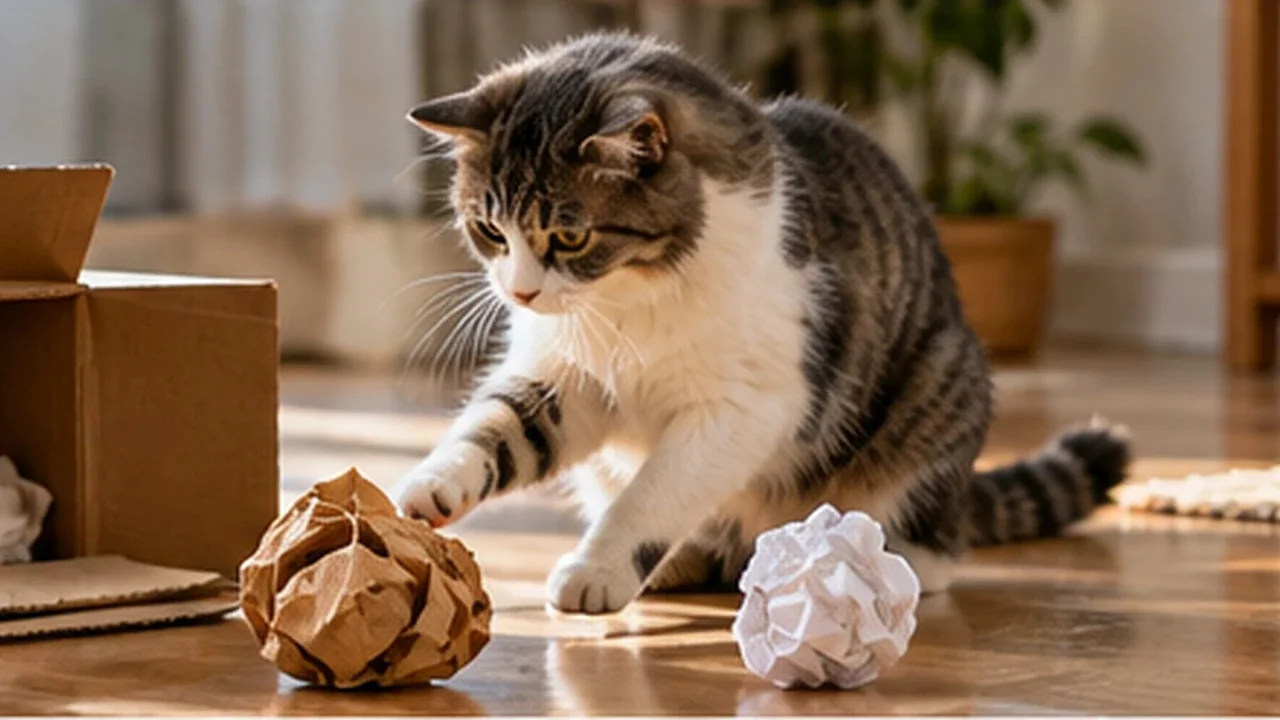
DIY Cat Toys Using Things You Already Have: A Safety-First Guide
Make simple cat enrichment activities with cardboard boxes and household items while avoiding unsafe strings, loose parts, and choking hazards.
Read the guide →Cat behavior and needs vary. For sudden behavioral changes, health concerns, or individualized medical advice, speak with your veterinarian.
← Explore more guides